

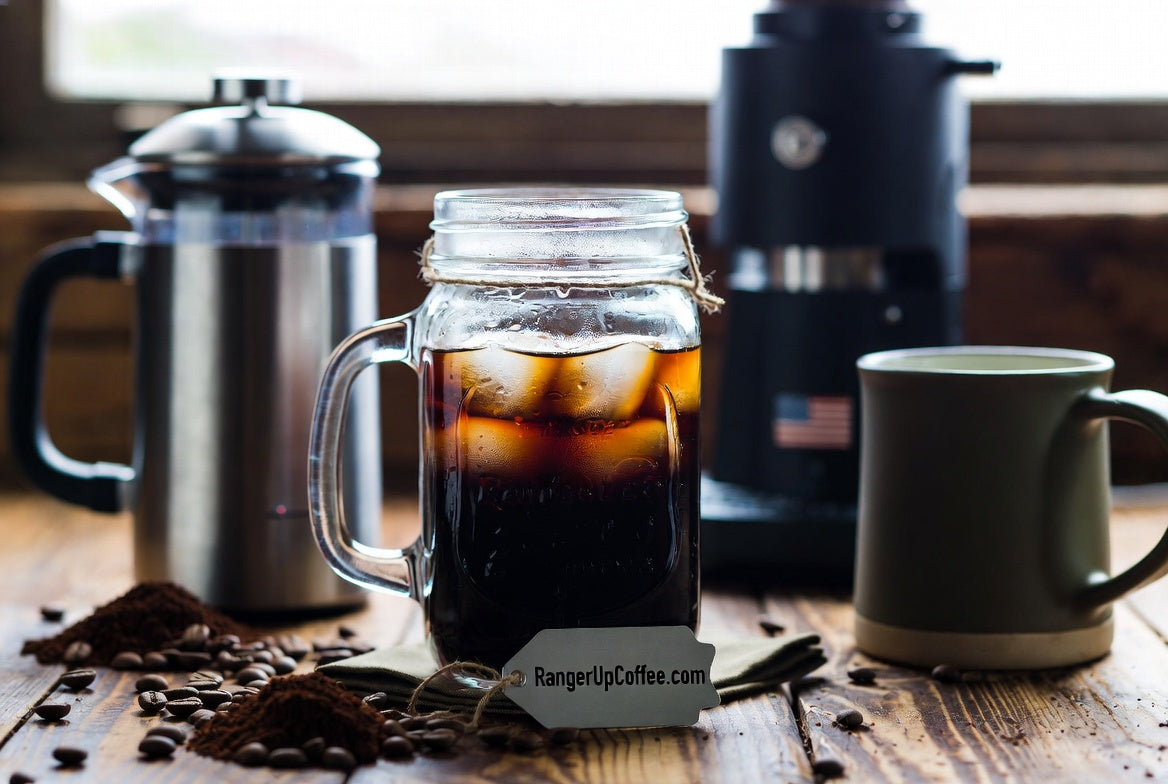
The Military-Grade Ultimate Guide to Making Cold Brew Coffee at Home
There’s a reason cold brew has taken over coffee coolers, social feeds, and morning routines across the country. Smooth, bold, naturally sweet, and low on the bitterness that can ambush a hot brew gone wrong, cold brew delivers a reliable mission-ready cup that works just as well on a scorching summer patrol as it does during a quiet winter desk shift. At Ranger Up Coffee, we roast single-origin beans and precision blends to order because freshness hits different. Pair that with a solid cold brew method and you’ve got fuel that keeps you sharp without the crash or the acid burn.
This guide breaks down everything you need to produce consistently excellent cold brew at home. No fancy barista school required. Just the right ratio, the right grind, a little patience, and quality beans. We’ll cover the science, the gear, step-by-step execution, variations, troubleshooting, storage, and why starting with freshly roasted Ranger Up Coffee makes a measurable difference. By the end you’ll have a repeatable system that rivals anything coming out of a specialty shop.
What Exactly Is Cold Brew (and Why It Tastes So Good)
Cold brew is coffee extracted with cold or room-temperature water over an extended period, typically 12 to 24 hours, rather than the rapid hot-water method used for drip, pour-over, or espresso. The long, gentle steep pulls out the desirable soluble compounds while leaving behind many of the acidic and bitter elements that hot water aggressively extracts.
The result is a concentrate that is smoother, slightly sweeter, and lower in perceived acidity. When diluted with water or milk and poured over ice, it stays robust instead of turning into watery disappointment the way traditional iced coffee often does. Caffeine levels can actually run higher than standard drip depending on the ratio and beans, giving you sustained energy without the jitter spike.
Cold brew isn’t new, versions of it have existed for centuries, but it exploded in popularity over the last decade as coffee drinkers demanded cleaner, more consistent cold options. Today it sits among the highest-searched coffee topics for home brewing, right alongside French press and espresso methods. That demand exists for a reason: when done right, it is simply excellent coffee.
Gear You’ll Need (Keep It Simple, Soldier)
You don’t need a $200 apparatus. Basic kitchen tools work fine. Here’s the essential kit:
- Coarsely ground coffee (more on grind size below)
- A large glass jar, pitcher, or dedicated cold brew maker (32 oz to 64 oz is ideal for home batches)
- Fine-mesh sieve, cheesecloth, nut milk bag, or paper filters for straining
- Kitchen scale (highly recommended for consistency) or measuring cups
- Filtered water
- Refrigerator space
- Optional but useful: airtight storage bottles for the finished concentrate
If you already own a French press, it doubles as an excellent cold brew vessel—just don’t plunge until the end. Dedicated systems with built-in filters speed up the process and reduce mess, but they’re not required.
Pro tip from the Ranger Up roasting floor: start with whole beans and grind them yourself right before brewing. Pre-ground coffee loses aromatic compounds quickly. Freshly roasted beans—especially single origins or carefully developed blends, give you the full flavor spectrum cold extraction is designed to highlight.
The Golden Ratio and Grind Size
Consistency starts with numbers. A reliable starting point for concentrate is a 1:5 to 1:8 coffee-to-water ratio by weight. That means:
- 100 grams of coffee to 500–800 grams (ml) of water for a strong concentrate
- Adjust to taste. Prefer it milder? Lean toward 1:8 or 1:10. Want it rocket-fuel strong? Stay closer to 1:4 or 1:5.
For volume cooks without a scale, roughly ¾ to 1 cup of coarsely ground coffee per 4 cups of water works as a ballpark.
Grind size is critical. Go coarse, think sea salt or breadcrumbs, similar to French press. Too fine and you’ll over-extract, creating sludge and bitterness that’s hard to filter. Too coarse and under-extraction leaves the brew weak and sour. A burr grinder gives the most uniform particle size. Blade grinders can work in a pinch if you pulse carefully and sift out the fines.
Water quality matters more than most people realize. Filtered or bottled water free of chlorine and heavy minerals lets the coffee’s natural character shine. Hard tap water can mute flavors or leave mineral deposits.
Step-by-Step: Making Cold Brew Concentrate
- Weigh or measure your coffee and grind it coarse.
- Add the grounds to your vessel.
- Pour in the measured room-temperature or cold filtered water. Stir gently to ensure every particle is saturated. No dry pockets.
- Cover the vessel. Let it steep at room temperature for the first few hours if desired, then move to the refrigerator, or go straight into the fridge for the full time. Total steep: 12–18 hours for most beans. Lighter roasts and denser single origins may benefit from closer to 18–24 hours. Darker roasts extract faster—check at 12–14 hours.
- When time is up, strain thoroughly. First through a fine-mesh sieve or French press plunger to remove bulk grounds, then through cheesecloth, a nut milk bag, or paper filters to clarify. Multiple passes yield cleaner concentrate.
- Transfer the concentrate to clean, airtight bottles or jars. It will keep in the refrigerator for 7–14 days, though peak flavor is in the first week.
To serve, dilute the concentrate 1:1 or 1:2 with cold water, milk, or a milk alternative over ice. Taste and adjust. Some prefer it black and strong; others add a splash of cream or a touch of simple syrup. The beauty of concentrate is control.
Advanced Tips for Military-Grade Results
- Agitation: A gentle stir halfway through the steep can improve even extraction without introducing excess fines.
- Temperature: Straight refrigerator steeping is most consistent and safest. Room-temperature steeps extract slightly faster but require closer monitoring.
- Bean selection: Medium to medium-dark roasts often shine in cold brew because the process softens any roast bitterness while highlighting chocolate, nut, and caramel notes. Bright African single origins (think Ethiopian Yirgacheffe) produce vibrant, fruity cold brews that surprise people expecting only “smooth and chocolatey.” Colombian and Central American lots deliver classic balance. Experiment. That’s half the fun.
- Batch size: Make enough for several days. Cold brew is ideal for meal-prep thinking—brew once, fuel multiple mornings.
- Secondary filtration: If your concentrate still looks cloudy, a final pass through a paper filter or coffee sock cleans it up dramatically.
- Scaling: The ratios hold whether you’re making a single jar or a gallon. Just keep proportions consistent.
Popular Variations to Keep Things Interesting
Once you master the base method, expand the mission:
- Nitro-style at home: After diluting, pour the cold brew back and forth between two pitchers or use a handheld milk frother to introduce tiny bubbles. The cascading effect and creamy mouthfeel approximate true nitro without special equipment.
- Flavored cold brew: Add a cinnamon stick, vanilla bean, citrus peel, or a few coffee cherries during the steep. Remove before final straining. Keep additions subtle so they complement rather than dominate.
- Milk-based versions: Dilute with oat, almond, or dairy milk and a touch of sweetener for a ready-to-drink latte style.
- Hot cold brew: Yes, it’s a thing. Dilute the concentrate with hot water for a smoother hot cup that skips some of the acidity of traditional brewing.
- Sparkling cold brew: Top diluted concentrate with sparkling water for a refreshing twist.
Common Mistakes and How to Avoid Them
- Using fine grind → muddy, bitter, hard-to-filter mess. Stay coarse.
- Under- or over-steeping → weak or harsh results. Start with 14–16 hours and adjust based on your beans and taste preference.
- Skipping the secondary filter → sediment in the glass. Take the extra two minutes.
- Storing in a non-airtight container → oxidation dulls flavor fast.
- Using old, stale beans → flat, lifeless concentrate. Fresh roast date is non-negotiable for peak results.
- Diluting too much or too little on the first try → taste as you go.
Storage, Shelf Life, and Serving Ideas
Concentrate lasts up to two weeks refrigerated in a sealed container, though flavor is brightest in the first 7–10 days. Never leave it at room temperature for extended periods after straining. Freeze portions in ice cube trays for longer storage—drop a cube into milk or water when needed.
Serve it black over ice, as the base for an iced latte, mixed into protein shakes, or even in cooking (coffee-rubbed meats or desserts benefit from the smooth profile). For an afternoon reset, a small glass of undiluted concentrate over a single large ice cube delivers focused caffeine without volume.
Why Ranger Up Coffee Beans Elevate Your Cold Brew
We roast to order near Fort Campbell, KY (Home of the 101st ABN DIV) so your beans leave our facility at peak freshness. Single-origin lots from Africa, Central America, and beyond, plus carefully crafted blends, give you distinct flavor profiles that cold extraction showcases beautifully. Because we prioritize quality green coffee and precise roasting over flashy packaging, more of your dollar goes into the cup. A portion of profits and all tips support homeless veteran charities, so every batch you brew does more than just wake you up.
Whether you grab our Colombian Supremo for classic balance, an Ethiopian for fruit-forward brightness, or one of the house blends built for everyday reliability, you’re starting with coffee that was roasted for the mission: maximum flavor, maximum freshness.
Final Thoughts: Own the Process
Cold brew rewards patience and attention to detail, the same traits that separate average results from excellent ones in any craft. Master the ratio, respect the grind, use fresh beans, and strain cleanly. Within a couple of batches you’ll dial in your personal preference and have a refrigerator staple that outperforms most commercial options at a fraction of the cost.
Print this guide, tape it inside a cabinet, and run the process a few times. Track your ratios and steep times the way you’d log range data. Small adjustments compound into consistent excellence. When you’re ready for the next level, explore different origins side by side or experiment with secondary flavorings.
Fresh coffee, properly extracted, remains one of the simplest high-performance fuels available. Brew a batch this weekend. Taste the difference quality beans and a solid method make. Then share the results—because good coffee, like a solid unit, is better when shared.
Stay sharp. Stay caffeinated. Ranger Up.
0 comments