

When it comes to coffee bean longevity, degassing, and volatile organic compounds, the industry standard is known as the "Rule of 15s" (or sometimes the 15-15-15 rule). However, many specialty roasters and baristas tighten this down to a strict 12-12-12 Rule to account for hyper-porous dark roasts and rapid oxidation. At Ranger Up Coffee we roast your coffee to order and ship it the next ensuring you get the freshest coffee possible. We are one of the only coffee roasters that ship fresh roasted coffee Kcups due to the patented pods we use that releases gasses similar to a one way valve on a coffee bag.
Let's dive straight into the actual science of coffee freshness, gas dynamics, and lipid oxidation.
The Science of Coffee Freshness: The 12-12-12 Rule
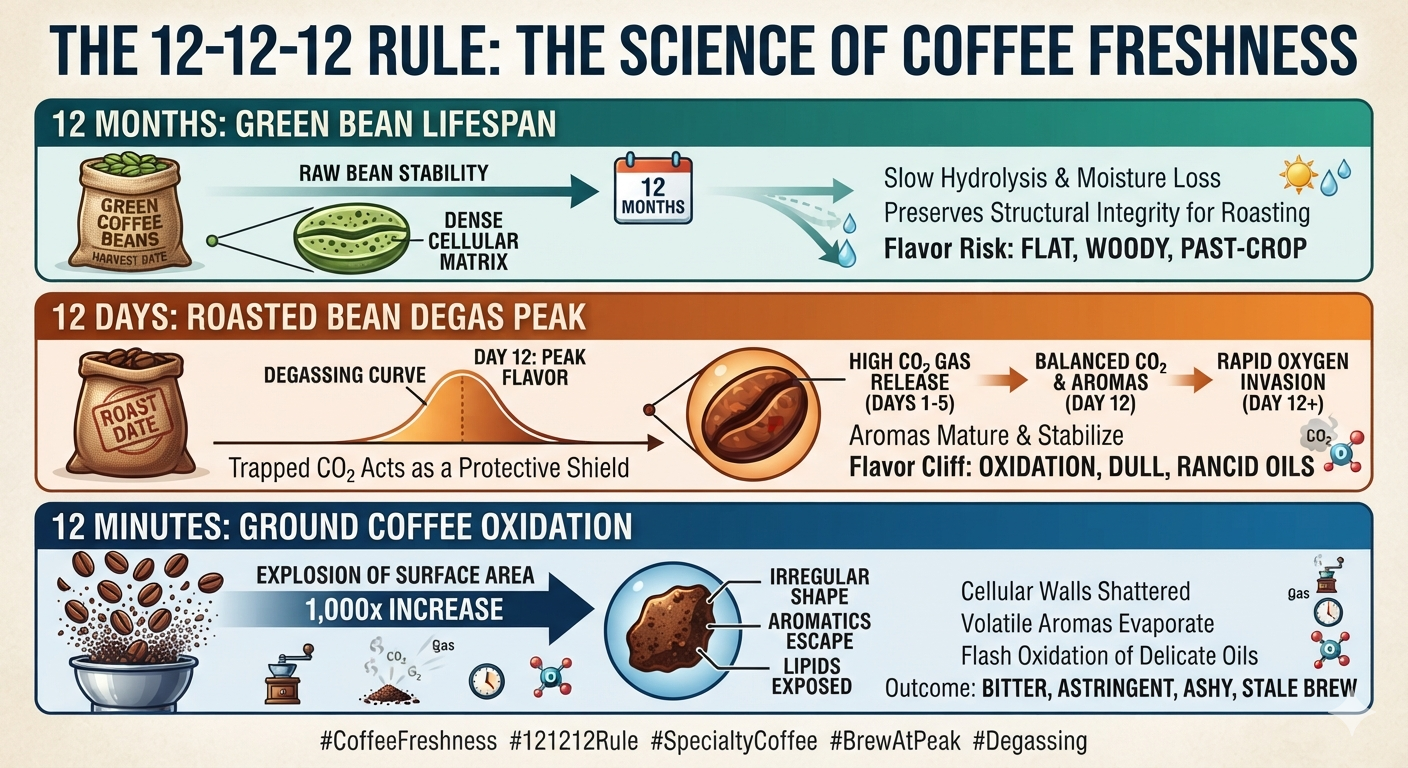
In specialty coffee chemistry, the 12-12-12 Rule represents the exact degradation timeline of a coffee bean's cellular structure, volatile aromatic compounds, and surface lipids.
- 12 Months for Green Beans: Raw, unroasted green coffee must be roasted within 12 months of harvest.
- 12 Days for Roasted Beans: Whole-bean roasted coffee hits its absolute flavor peak and begins a rapid decline 12 days after roasting.
- 12 Minutes for Ground Coffee: Once cellular walls are shattered by a grinder, oxygen destroys the delicate oils and aromas within 12 minutes.
Here is a scientific breakdown of exactly what happens to your coffee at each stage of this timeline.
12 Months: The Green Coffee Cellular Clock
Before a coffee bean is roasted, it is a dense, green seed inside a fruit. Green coffee is surprisingly stable, but it is not immortal. It contains water (ideally a 10% to 12% moisture content), proteins, carbohydrates, and lipids trapped inside a rigid cellulose matrix.
[Green Coffee Harvest] ──► (Hydrolysis & Moisture Loss) ──► [12 Months] ──► (Stale "Baggy" Flavors)
The Breakdown: Hydrolysis and Oxidation
Even raw coffee seeds breathe. Over the course of 12 months, the raw bean undergoes slow chemical changes:
- Moisture Loss and Hydrolysis: The organic moisture inside the green bean gradually evaporates. If the water activity drops too low, the essential chemical reactions needed during the future roasting process (like the Maillard reaction) cannot execute properly.
- Lipid Oxidation: Raw coffee contains structural lipids (fats). Over a year, ambient oxygen slowly penetrates the grain, breaking down these fatty acids into oxidative byproducts.
The Result: Coffee roasted past its 12-month green harvest date loses its vibrant, crisp acidity. It begins to taste flat, woody, and paper-like—a flaw roasters refer to as "baggy" or "past-crop" flavor.
12 Days: The Roasted Bean Degassing Curve
When coffee is roasted, the intense heat triggers a massive chemical transformation. The sugars caramelize, the amino acids bind, and the cell structure undergoes pyrolysis—splitting apart and generating a massive amount of carbon dioxide (CO₂) trapped within the bean's newfound porous pockets.
[Day 0: Roast] ──► (Day 1-5: Heavy Degassing) ──► [Day 12: Peak Flavor] ──► (Day 13+: Rapid Oxidation)
The Chemistry: The CO₂ Shield and Degassing
For the first few days after a roast, the coffee bean is actually too fresh to brew cleanly. The internal pressure from trapped CO₂ gas is so intense that if you pour hot water over the grounds, the escaping gas physically pushes the water away. This blocks proper water-to-coffee contact, resulting in an uneven, sour extraction.
- Days 1 to 4: Heavy, chaotic degassing.
- Days 5 to 11: The gas pressure stabilizes. The flavors open up, and the structural aromatics mature.
- Day 12: The optimal equilibrium point. The structural CO₂ pressure drops just low enough to allow perfect water saturation, while still acting as a protective shield against oxygen entering the bean's pores.
Why Day 12 is a Cliff: The Oxidation Onset
Once you pass day 12, the protective internal gas pressure drops below a critical threshold. Ambient oxygen moves into those empty, porous cellular pockets.
Coffee contains volatile organic compounds (VOCs)—specifically aldehydes, pyrazines, and esters—which give coffee its incredible fruity, floral, and nutty aromas. Oxygen immediately attacks these molecules, turning vibrant, highly reactive aromatics into stale, dull compounds.
12 Minutes: The Ground Coffee Surface Area Explosion
The most volatile, unforgiving rule of coffee chemistry happens at the grinder. Whole coffee beans act as little protective vaults. When you run them through a grinder, you break open those structural vaults, exposing everything inside to the air.
[Whole Bean Vault] ──► (Grinder Shatters Walls) ──► 1,000x Surface Area ──► [12 Minutes] ──► Stale
The Math of Surface Area
When you grind a single coffee bean for espresso or pour-over, you instantly shatter it into tens of thousands of microscopic fragments. This increases the total surface area exposed to oxygen by a factor of roughly 1,000x to 2,000x.
The Escape of Volatiles and Lipid Rancidity
The moment coffee is ground, two destructive processes happen simultaneously on a micro-scale:
- Immediate Outgassing: The remaining protective CO₂ gas violently escapes into the air within seconds.
- Flash Oxidation: The delicate lipids and essential coffee oils (which carry the true flavor profile) are completely exposed to oxygen.
If ground coffee sits out in an open basket for more than 12 minutes, the majority of its aromatic compounds simply evaporate into the room. The oxygen turns the exposed oils rancid, transforming what should be a sweet, complex cup into a bitter, ash-like, or papery brew.
The Freshness Guide: How to Apply the Rule
To ensure your brewing matches the science of the coffee bean, apply these specific habits:
- Look for a Roast Date, Not an Expiry Date: Never buy grocery store coffee that only lists a "Best By" date. Buy from specialty roasters who proudly stamp an exact, transparent roast date on the bag.
- Target the Window: Buy whole beans and aim to brew them between day 5 and day 20 post-roast.
- Grind Under 12 Minutes: Never use pre-ground coffee if you can avoid it. Keep your grinder right next to your coffee machine, and make sure your water is hot and ready before you press the grind button. Keep that ground coffee exposure under 12 minutes.
- Airtight, Dark Storage: Store your whole beans in an opaque, airtight container equipped with a one-way degassing valve. This allows any escaping CO₂ to leave the container without letting damaging oxygen slide inside.
0 comments